Here are some impressions from the practical study.
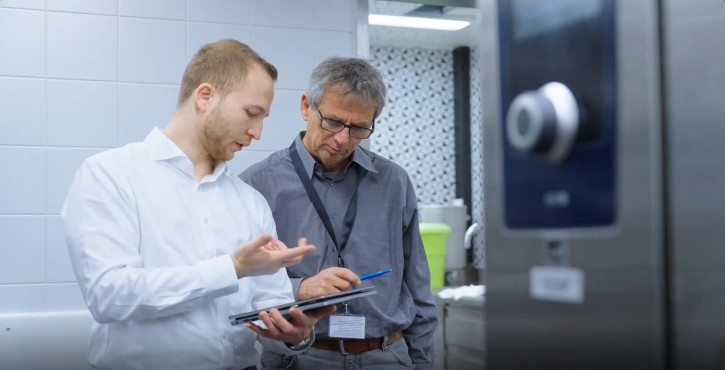
Explore the full-length video, white paper and other exclusive content related to the study.
Less power consumption despite a high connected load?
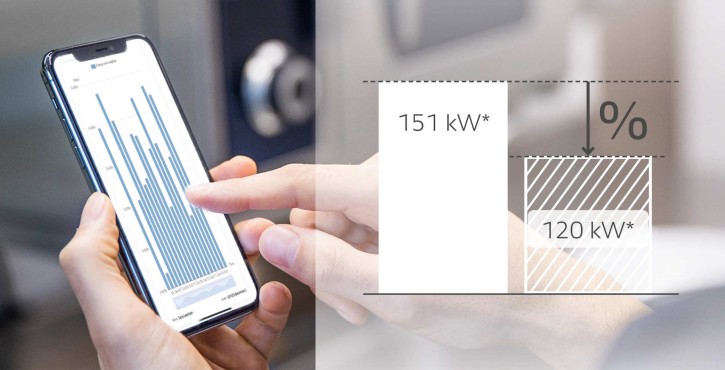
The study also proves that the high connected load of modern cooking systems does not lead to high energy consumption and thus high electricity costs, as is often incorrectly assumed. In fact, current peaks are reduced compared to conventional cooking technology. This is a result of:
- Short heat up times
- High efficiency
- Precise and flexible heat control
*Power peaks at 15-minute intervals in the old kitchen (left) and in the new kitchen (right)
Would you like to find out more?
Explore the full-length video, white paper and other exclusive content related to the study.
- Time period: 2022-2025, including pre-planning and evaluation
- Scientific support: Weihenstephan-Triesdorf University of Applied Sciences
- Old production kitchen from 2004 with various retrofits of kitchen technology
- Renovation period: April - September 2024
- Commissioning of the new production kitchen: September 2024
- Two comparable measurement phases over 17 weeks each (10/10/2023 to 31/01/2024 and 04/11/2024 to 28/02/2025)
- Recording of energy and water consumption, information on staff load (ergonomics), process changeover and the resulting flexibility of production as well as changes in food quality
- 93 electricity meters and 28 water meters
- Evaluation of more than 52,000 main courses in each measurement phase, more than 355,000 cash register transactions
- Evaluation software used for consumption: Grafana
- Participating companies: AXA Konzern AG, Eurest Germany GmbH, RATIONAL AG
AXA Konzern AG, Cologne site
With a premium income of €12 billion in 2023 and around 8,000 employees, AXA Konzern AG is one of Germany's largest primary insurers. AXA Konzern AG (AXA Germany) is part of the AXA Group, which is one of the world's leading insurance companies and asset managers. The group operates in Europe, North America, and the Asia-Pacific region. Approximately 3,500 employees at the Cologne site are able to use the company's catering service. On average, around 1,600 of these employees are on site each day. The catering service offers a breakfast and lunch service as well as a wide variety of snacks for in between meals. The lunch service, which is the focus of the study, is served in two restaurants.
Eurest Germany GmbH
Eurest has been contracted to provide catering services for employees of the AXA Konzern AG at its Cologne site. Around 25 Eurest employees are responsible for production at the site. While the menu and food procurement are based on Eurest's central structures, they are carried out in close consultation with colleagues from the AXA Workplace and Infrastructure Management Catering Division.
RATIONAL AG
RATIONAL AG, the market leader in thermal food preparation, commissioned the comprehensive study and provided operational consulting and training services to support the kitchen renovation. For RATIONAL, the study provides scientific confirmation of what has already been demonstrated in countless laboratory tests over many years: that RATIONAL technology can deliver impressive results in everyday kitchen operations.
Weihenstephan-Triesdorf University of Applied Sciences
Weihenstephan-Triesdorf University of Applied Sciences is one of the leading national and international universities of applied sciences and green engineering. Excellent teaching, a strong practical focus and applied research form the core of the university's identity. No other German university offers such a wide range of subjects geared towards green engineering. Across its seven faculties and two campuses, the university offers 19 bachelor's and 13 master's programmes covering ecological, technical, and economic topics.
Prof. Dr. Michael Greiner
Prof. Dr. David Brunner
Electricity consumption in restaurants depends on operating hours, the size of the establishment and the number of guests. For example, a company restaurant that is mainly equipped with traditional appliances and prepares around 1,600 meals a day requires around 0.5 kWh per hot meal. According to a study by Weihenstephan-Triesdorf University of Applied Sciences, this consumption can be reduced by 24.1% if the kitchen is equipped with modern and intelligent technology, such as cooking systems from RATIONAL.
The water demand in the catering industry can vary greatly depending on the type and size of the business. A company restaurant that is mainly equipped with traditional equipment and prepares around 1,600 meals a day, for example, requires around 2.9 litres of water per hot meal. A study by Weihenstephan-Triesdorf University of Applied Sciences has shown that this consumption can be reduced by almost half (47.9%) with the right kitchen equipment.
Energy costs in the catering industry can vary greatly, depending on the size of the business, operating hours and the equipment used. Monthly peak loads are particularly important, as monthly energy costs are usually based on the highest measured value – this is also a major factor in reducing energy costs.
For example, a company restaurant that prepares around 1,600 meals a day and mainly uses traditional appliances has an average power consumption of 151 kW per month. According to a study by Weihenstephan-Triesdorf University of Applied Sciences, this figure can be reduced by around 20.5% to 120 kW using modern technology such as the iCombi Pro and iVario Pro from RATIONAL. At a rate of £100 per kW, this could save £3,000 per month and £36,000 per year.