The main reason why kitchens are often planned too small is less their operational importance than their cost structure, explains Noah Birnbaum, a trained kitchen consultant responsible for commercial kitchen concepts at RATIONAL, the world market leader in thermal food preparation. "Kitchens are among the most expensive areas of a building. As wet rooms, they require tiled floors and walls, special screeds, and high-performance exhaust and ventilation systems. The larger the kitchen, the more complex – and expensive – this technical infrastructure becomes.“
News – 2026-05-13
When new buildings such as hospitals, care homes, schools or staff canteens are being designed, the kitchen is often relatively small, despite having to cover a wide range of functions. To ensure they can still operate efficiently, new design approaches are emerging: fewer individual appliances and more multifunctional technology that combines flexibility and capacity.
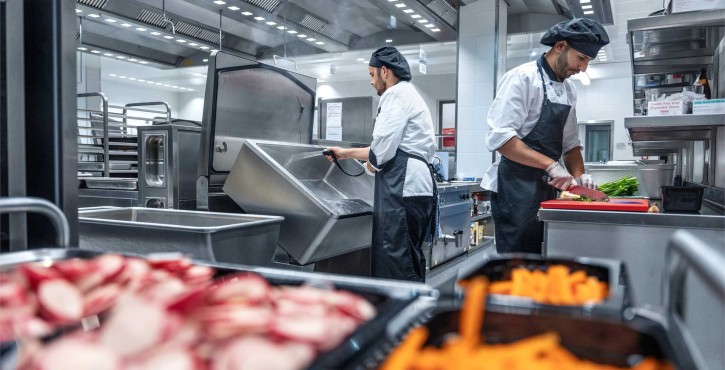
Many designers and building owners therefore try to minimise the kitchen area from the outset. The challenge is to meet all the demands of everyday kitchen operations despite limited space. Modern catering kitchens must accommodate a wide range of cooking methods, such as boiling, roasting, deep frying, and pressure cooking, as well as cope with fluctuating capacities and produce different menus simultaneously while ensuring smooth, efficient workflows. "The available space is shrinking, but the tasks remain the same or are even becoming more demanding," says Birnbaum.
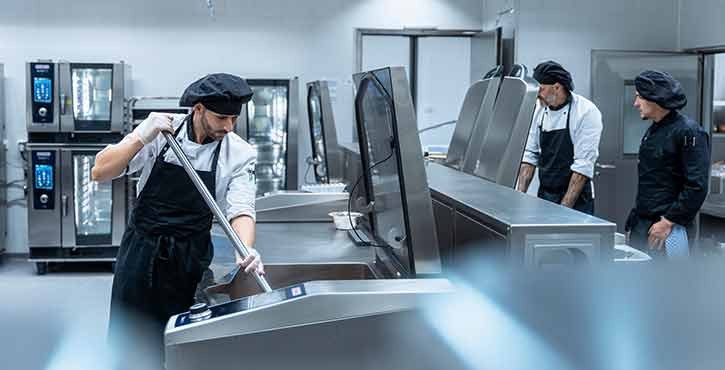
From a planning perspective, the advantages are clear: less space is required, there are fewer connections, installation and ventilation costs are reduced, and greater flexibility is afforded to the layout. Furthermore, such solutions enable production priorities to be adjusted flexibly, for example in response to changing menus or temporary surges in demand. Birnbaum says, "In many projects, we see that multifunctional technology either saves space or significantly increases production capacity within the same space." This can be crucial, particularly in facilities with growing catering needs and a fixed spatial layout. Rather than extending the building, the existing space can be used more efficiently.
A lack of space in industry catering is not a short-term phenomenon, but rather the result of long-term construction and cost trends. This makes early, holistic planning all the more important, and multifunctional cooking systems can be an effective tool in this regard, provided they are sensibly integrated into the overall concept. “Ultimately, it’s about designing kitchens in such a way that they support day-to-day operations as effectively as possible,“ Birnbaum summarises. "This doesn't mean having more technology, but using it wisely."